Corporate Information
Health Management Initiatives

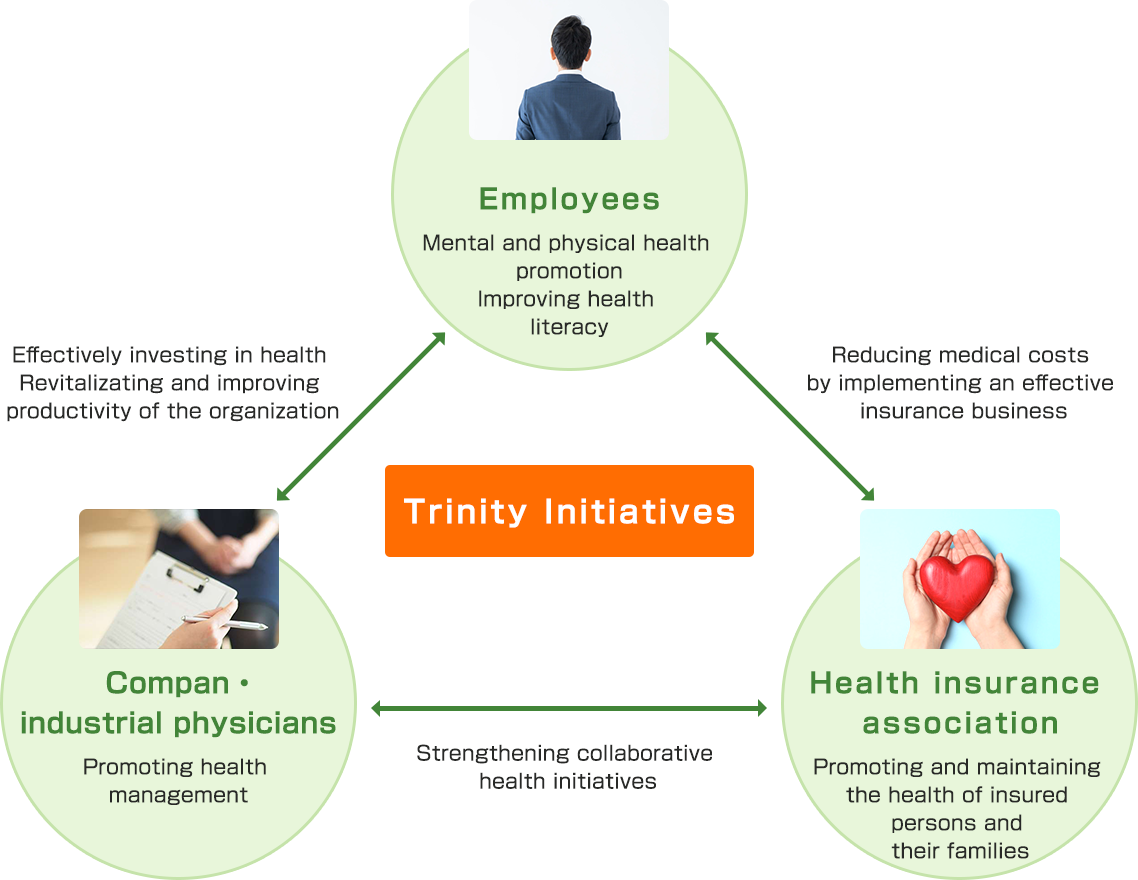
We believe that for our philosophy to be realized, it is essential that our employees lead vibrant lives both at work and in their personal time. We consider that ensuring the physical and mental wellbeing of our workforce is at its optimum state leads to the harmonization of corporate and social value, and contributes to the happiness of our employees and their families. To this end, we have established a "Health Management Basic Policy" and formulate annual plans. We actively promote measures to enhance health literacy and maintain/improve physical and mental wellbeing, including prevention of lifestyle-related diseases and their progression, women's health promotion, cancer prevention, infectious disease countermeasures, smoking cessation initiatives, and mental health support. Our aim is to be a company where employees can approach their work with vitality.
Health Management Basic Policy
Orient Corporation (hereinafter referred to as "we") has established the following "Health Management Basic Policy" based on its "Philosophy" and "Orico's Sustainability Statement". In order to achieve our goals, it is important that our employees are both physically and mentally healthy so that they can lead vibrant lives both professionally and privately while at work.
- We strive to create an organizational culture that prioritizes employee well-being, with management taking the lead.
- We commit ourselves to the health of our employees and their families and actively support their health.
- We increase each employee's overall health literacy and encourage independent healthy practices through education and training related to health promotion.
- We create a workplace where employees can continue to work energetically and comfortably through efforts to maintain and improve their health.
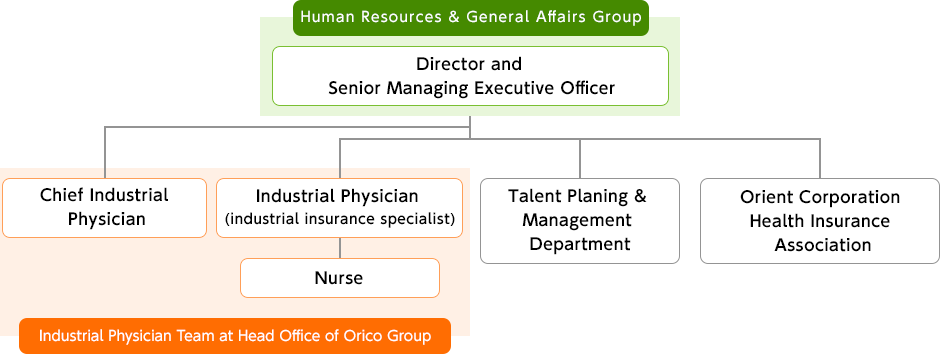
Establishing a Structure
The Significance of Pursuing Health Management
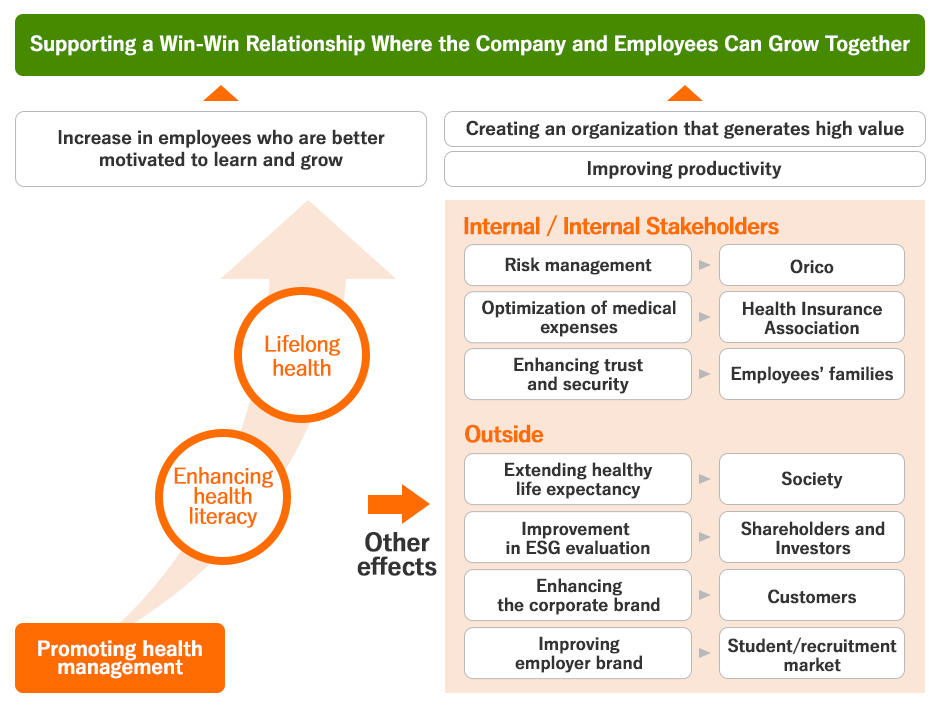
Health management is an essential element in advancing human resource strategy, and we believe it is vital that employees and their families remain healthy. By actively encouraging employees to improve their health literacy and maintain and enhance their physical and mental wellbeing, the Company will increase the number of employees who are more motivated to learn and grow. This will foster the creation of an organisation that generates high value and improves productivity, thereby supporting the development of a mutually beneficial relationship between employees and the Company and maximizing employee engagement.
Investment in Health Management
| FY2021 | FY2022 | FY2023 | FY2024 |
|---|---|---|---|
| 153 million yen | 192 million yen | 192 million yen | 178 million yen |
Health Management Top Management Training Program
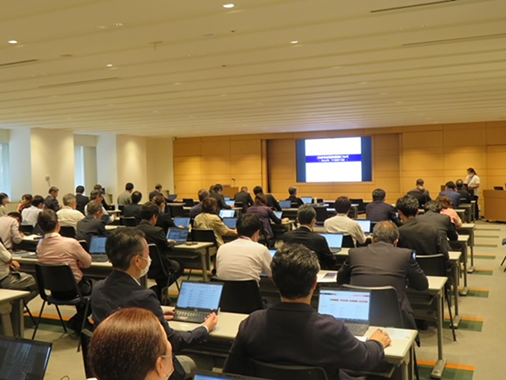
In October 2025, we conducted training on health management for all organizational leaders, including Executive Officers, Directors and Presidents of group companies, by inviting an external lecturer. Concurrently, we made a video recording of this training available to all employees to enhance understanding of health management and improve staff health literacy.
Selected for the 2025 KENKO Investment for Health Stock Selection
We have been selected as an enterprise under the 2025 KENKO Investment for Health Stock Selection by Japan's Ministry of Economy, Trade and Industry (METI) and Tokyo Stock Exchange for the first time in light of its efforts with regard to its employees' health from a management perspective.

Furthermore, we have been certified as a "KENKO Investment for Health ("White 500" Enterprise)" under the Health Management Excellence Organization Certification System, jointly organized by the Japan Health Council and the Ministry of Economy, Trade and Industry. We will continue to pursue health management initiatives, creating a supportive workplace environment that enables each employee to lead a vibrant life both professionally and personally, while supporting the maintenance and enhancement of their physical and mental wellbeing.
Awarded "DBJ Health Management Ratings"
The Development Bank of Japan Inc. has awarded us its highest rating (Grade A) in the DBJ Health Management Ratings. This formal rating evaluates and selects companies demonstrating outstanding initiatives in caring for employee health and working practices. Our Company was recognized for establishing an advanced health management framework, implementing various initiatives to maximize employee engagement, and formulating and executing human resource development strategies aligned with our business strategy.
Health and Safety Committee
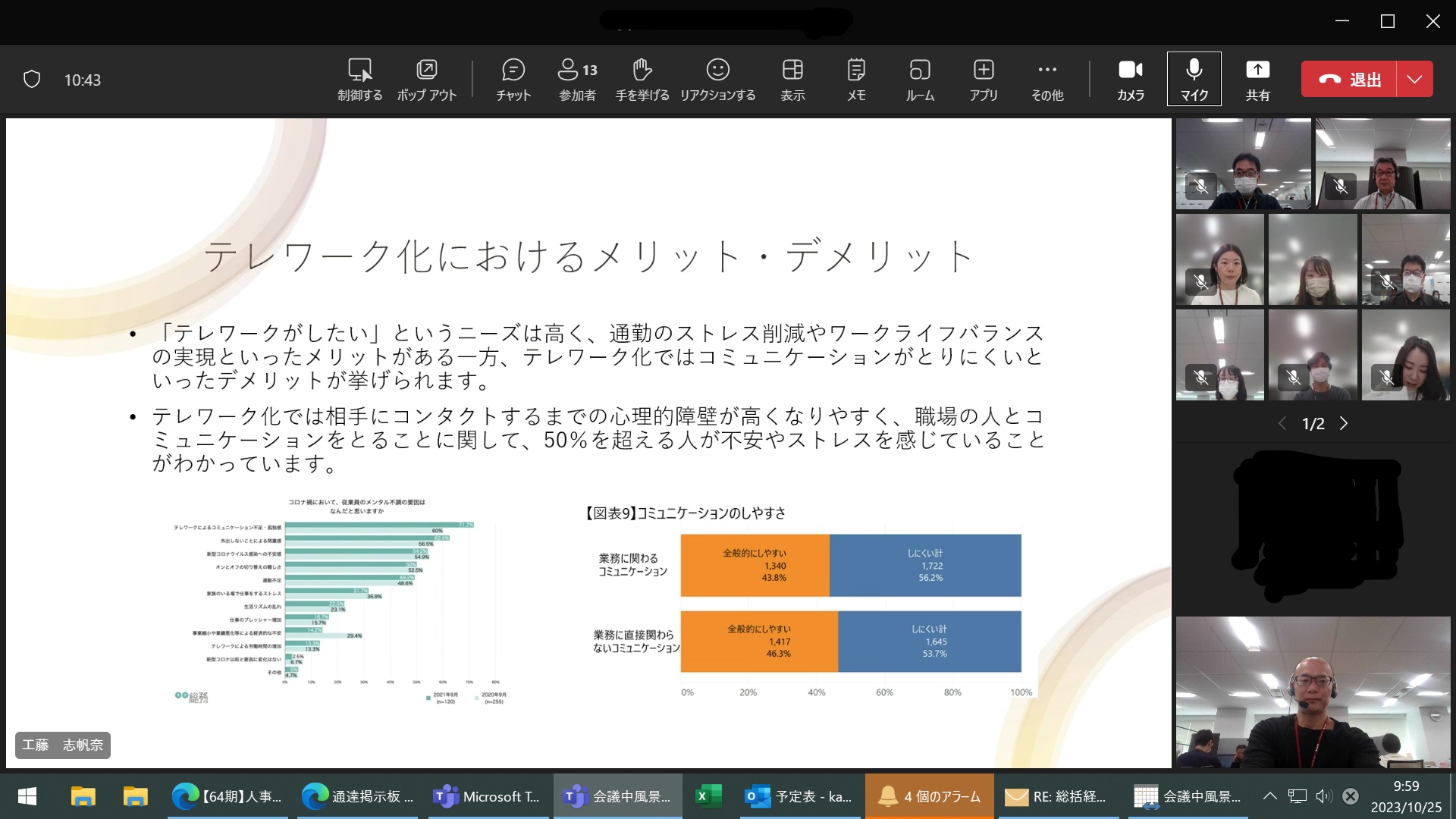
- We have appointed 34 Health and Safety Managers and 44 Health and Safety Promoters across our 72 branches, centers and offices nationwide. (As of April 2025)
- Through the realization of a comfortable workplace environment and the improvement of working conditions, we aim to safeguard the health of our employees in the workplace and foster a dynamic organization. To this end, we facilitate regular consultations between management and labor, alongside communication among employees.
- The number of occupational accidents in the fiscal year 2024 was 31. The Health and Safety Committee analyzed the causes of each accident and is working to prevent recurrence by considering and implementing countermeasures.
Participation rates for each initiative and employee health indicators
Each target value has been established as our Company's proprietary evaluation metric, drawing upon data from the Ministry of Health, Labour and Welfare's "National Health and Nutrition Survey" and published figures from companies implementing advanced initiatives.
| Classification | Item | Actual figures | |||||
|---|---|---|---|---|---|---|---|
| Target | FY2021 | FY2022 | FY2023 | FY2024 | |||
| Periodic health examinations | Received for periodic health examinations rate | 100.0% | 100.0% | 100.0% | 100.0% | 100.0% | |
| Continuation rate of health guidance for high-risk individuals | 100.0% | 100.0% | 100.0% | 100.0% | 100.0% | ||
| Precision examination attendance rate | 100.0% | 48.2% | 76.8% | 76.5% | 83.7% | ||
| Specific health guidance implemented rate | 55.0% | 37.7% | 56.5% | 60.1% | 59.5% | ||
| Persons maintaining an appropriate body weight rate | 70.0% | 63.3% | 66.6% | 65.6% | 62.2% | ||
| Breast cancer screening uptake rate (Age 35 and over) *At our expense | - | 58.1% | 56.9% | 54.8% | 54.7% | ||
| Uterine cancer screening uptake rate (Age 35 and over) *At our expense | - | 41.1% | 38.6% | 38.7% | 37.6% | ||
| Prostate cancer screening uptake rate (Age 45 and over) *At our expense | - | 70.8% | 68.5% | 66.5% | 69.9% | ||
| Lifestyle habits and infectious disease prevention | Smoking rate | 12.0% | 24.3% | 22.9% | 23.0% | 22.3% | |
| Exercise habit ratio *1 | 40.0% | 17.8% | 18.7% | 16.5% | 20.0% | ||
| Quality of sleep *2 | 80.0% | 55.1% | 60.8% | 54.3% | 54.0% | ||
| Mental health | Stress check participation rate | 100.0% | 91.8% | 95.1% | 96.2% | 95.3% | |
| High stress individual rate | 10.0% | 13.0% | 12.9% | 11.8% | 11.5% | ||
| Productivity | Paid leave acquisition rate | - | 66.8% | 69.4% | 70.9% | 70.4% | |
| Number of occupational accidents | - | 43 cases | 34 cases | 42 cases | 31 cases | ||
| Presenteeism *3 | - | - | 16.9% | 19.4% | 18.2% | ||
| Number of individuals measured | - | - | 5,690人 | 5,502人 | 5,383人 | ||
| Response rate | - | - | 95.1% | 96.2% | 95.3% | ||
| Absenteeism *4 | - | 2.1 days | 1.6 days | 1.7 days | 2.2 days | ||
| Number of workers on sick leave | - | 26 people | 33 people | 51 people | 33 people | ||
| Occurrence rate | - | 0.6% | 0.6% | 0.9% | 0.6% | ||
| Work engagement *5 | - | 48.3 | 48.5 | 48.5 | 48.9 | ||
| Number of individuals measured | - | 6,061 people | 5,690 people | 5,502 people | 5,383 people | ||
| Response rate | - | 91.8% | 95.1% | 96.2% | 95.3% | ||
| Employee awareness | POS score *6 | 80.0% | - | 64.2% | 66.8% | 73.1% | |
| Employee health literacy *7 | 80.0% | - | - | 60.5% | 61.8% | ||
*1 Exercise habit ratio: The percentage of employees who engage in light exercise that causes mild sweating for 30 minutes or more at least twice a week for over a year.
*2 Quality of sleep: The percentage of employees who feel adequately rested from sleep.
*3 Presenteeism: Calculated using the QQ-method. The percentage of employees whose work quantity and quality decline to about one-third compared to normal when they have symptoms.
*4 Absenteeism: Average number of days utilized for the leave system due to employee illness or injury.
*5 Work engagement: The deviation scores of the evaluation points for "I feel energized when I am working" and "I take pride in my work".
*6 POS Score: Percentage of positive evaluations of the Company's health support and programs.
*7 Employee health literacy: Percentage of employees able to access health and medical information and take action to improve their health.